Census 2021: Disability Inequality Islands.
Disability is not experienced equally across England. Where you live, how old you are and the economic history of your region all shape whether and how severely you are affected.
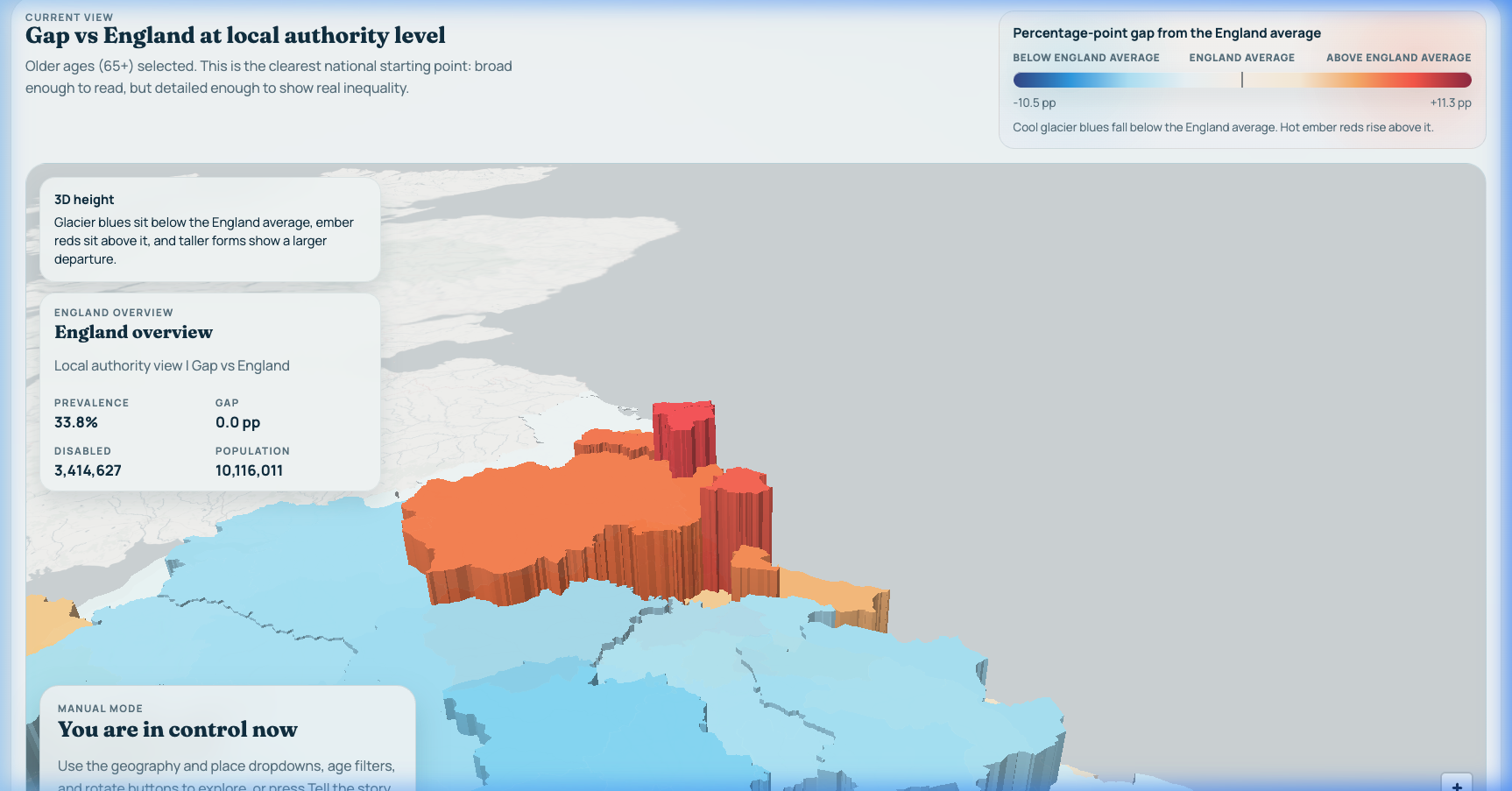
Explore the map
A detailed geographic breakdown of the 2021 England Census showing inequality in disability prevalence.
The Census 2021 data makes the unequal distribution of disability visible in stark geographical relief. A national average tells one story. Local authorities, regions and age groups tell a much more uncomfortable one.
The "Disability Inequality Islands"
When we step back and look at the national picture, about 16.9% of the population in England, approximately 9.36 million people, are classified as disabled under the Equality Act. But that single figure is a statistical mask.
It hides what I call the Disability Inequality Islands: pockets of the country, primarily in the North, where disability is not just common but endemic, and where the experience of being disabled is shaped by poverty, post-industrial decline and limited access to support.
Using the metric Gap vs England, the percentage point difference between an area's prevalence and the national average, we can visualise the disparity clearly. These are not just spots on a map. They are terrains where the social and economic architecture of health has failed, and where the burden of disability falls disproportionately on those least equipped to absorb it.
Older people: the sharp margin
The disparity is most aggressive among older cohorts. National averages are useful for headlines, but the reality for people aged 65 and over in the North East is radically different from the reality for their counterparts in the South East.
In these northern islands, the acceleration of disability with age is steeper. We are not just seeing more disabled people. We are seeing a compression of healthy life that hits harder and earlier in post-industrial heartlands, where the structural conditions that protect health were stripped away a generation ago.
The northern extremes
The spread of disability prevalence across the country is profound. Across all local authorities, there is a 14.0 percentage point difference between the severest concentration and the lowest occurrence.
- The peak: Blackpool registers the highest prevalence at 24.4%, 7.6 percentage points above the England average, closely followed by Sunderland, Liverpool and Torbay.
- The trough: At the other end is the City of London at 10.4%, 6.5 percentage points below the England average.
A tale of two countries
At regional level the disparities calcify into a familiar, brutal divide. The North East runs hot with prevalence of 20.2%, 3.4 percentage points above England, punctuated by extreme local concentrations over 22%. London and the South East sit at substantially lower rates.
The 7.0 percentage point gap between the North East and London is not just a statistical artefact. It represents millions of lived experiences shaped by post-industrial legacies, age distributions and economic disparity.
Conclusion: engineering the terrain
The map shows in unambiguous relief that disability is not one shared experience. It is fractured by geography, age and economic history. The gap operates as a proxy for broader regional disparities, and the data makes clear that where you are born shapes not just whether you become disabled, but when and how severely.
To close that gap, policy has to target the terrain where the disparities are deepest. We need to look at these inequality islands not as anomalies, but as the front line of a national health crisis.